


Your child works hard and gets decent marks. But you look at the job market ahead and feel a quiet worry. Knowing how to recall facts for a board exam is not the same as knowing how to spot a problem, pitch a fix, or manage money under pressure. So the question forms: is entrepreneurial thinking something a child either has or doesn’t, or is it a skill that school can actually build?
This matters more than it might seem. The World Economic Forum’s Future of Jobs Report 2025 projects that 39% of workers’ core skills will change by 2030. Analytical thinking, creative problem-solving, and resilience top the list of what employers say they need. If those skills take years of practice to build, waiting until college to start is a real cost.
For families across Hyderabad, from Miyapur, Tellapur and Gopanpally to Chanda Nagar,
Nizampet and Kukatpally, that makes the school you choose a question about skills as well as marks.
The “Born Entrepreneur” Myth, and Why It Persists
The idea that entrepreneurs are born, not made, is easy to believe. We see bold founders in the news and assume they arrived that way. But boldness is visible. The years of practice behind it are not.
Research tells a more useful story. A meta-analysis of 73 studies, covering over 37,000 people, found that entrepreneurship education has a small but real positive link to entrepreneurial intentions. The effect is modest. The researchers were honest that it was not significant after controlling for students’ existing mindset before the program began. That caveat matters: one course does not turn a reluctant student into a founder. What it does, when built into a school’s daily structure over years, is something different.
A 16-year follow-up of alumni from Sweden’s Junior Achievement Company Program found that students who ran a real small company during school were more likely to start firms and earned more entrepreneurial income than matched peers. Firm survival rates were the same, which is worth knowing. But the act of starting, the hardest step, happened more often for those who had practiced.
The pattern holds: research on entrepreneurship education shows it builds mindset, specifically communication, opportunity recognition, and critical thinking, and that mindset connects to career readiness. It does not promise a successful business. But it raises the odds that a student will try, and try with better tools.
Which Skills Actually Turn Students into Entrepreneurs?
“Entrepreneurship” is a broad word. It helps to break it into the specific skills that make it real.
Problem-spotting. Before any business exists, someone has to notice a gap. This is a trained habit, not a personality trait. Students who are regularly asked “what’s broken here, and how would you fix it?” build this faster than those who are only asked “what is the answer?”
Financial thinking. Knowing that money exists is not the same as knowing how it moves. Budgeting, interest, and the gap between revenue and profit are all learnable. Students who meet these ideas early, in real settings, are less likely to be caught out by them later.
Communication and pitching. The ability to explain an idea clearly, adjust for the audience, and handle pushback is one of the most useful skills a young person can build. It serves job interviews, client calls, and team work equally.
Resilience and iteration. Trying something, having it fail, and adjusting rather than quitting is a skill with a learning curve. Schools that create low-stakes spaces for failure build this faster than those where every test is high-stakes and final.
None of these are personality traits. All of them respond to practice.
The challenge, as panelists at a 2025 education summit noted, is that skills-based education faces real structural barriers: employers, educators, and institutions often use different languages to define and measure these skills. Schools that bridge that gap, by giving students real projects and real feedback from real professionals, have a clear edge.
What Skill-Based Entrepreneurial Education Looks Like at Meru in Hyderabad
Meru International School’s approach is built around M-CLAP, a program covering Entrepreneurship, Financial Literacy, Life Skills, and Career Counselling from Early Years to Grade 12 across the Miyapur, Tellapur, and Gopanpally campuses. The Miyapur campus is at Madeenaguda, Chanda Nagar, and the Tellapur campus is next to My Home Tridasa.
The design is step-by-step. Financial literacy starts early, with budgeting, banking, interest rates, and fraud protection in the lower grades, then moves to behavioural economics, investments, and digital currencies in Grades 9 to 12. Life skills follow the same logic: public speaking and teamwork in early grades, leadership and critical thinking in the middle years, job-readiness and networking in the upper grades. The entrepreneurship strand takes students through ideation, business modelling, marketing, branding, and finance, using pitch-deck work as a core output, not a one-off event.
The most visible part of this is Meru Pravinya, the school’s annual entrepreneurship Ideathon in Hyderabad. Students solve real-world problems, pitch business ideas to industry experts and entrepreneurs, and compete as teams. This is not a club activity. It is a structured, assessed event with external judges.
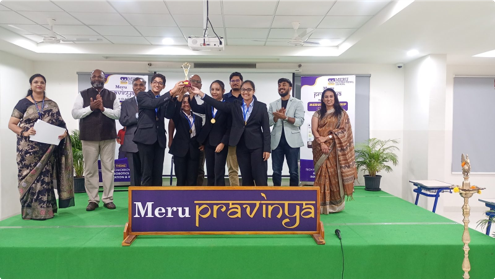
Celebrating on stage at Meru Pravinya 2025. Photo: Meru International School.
Pravinya 2025 brought together 480 students from Grades 5 to 12, working in 80 teams under the theme “AI and Robotics for a Better Tomorrow.” Projects included NutriScan AI (the championship winner), RHAAS (a highway rescue system), Gesture Link (sign-language translation), EcoStride AI shoes, and AquaSOS (a fishermen’s safety tool). These are student ideas and prototypes, not launched companies. But the thinking behind them, spotting a real problem,
designing a fix, building a case for it, and pitching it to experts, is exactly the practice that research says matters.
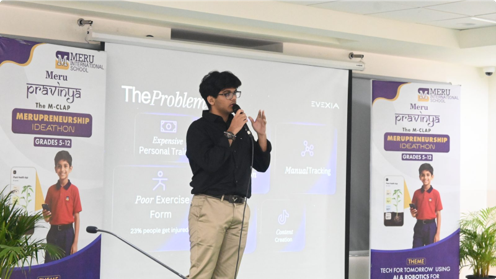
A presenter pitching at Meru Pravinya 2025. Photo: Meru International School.
Meru’s founder, Meghana Gorukanti Jupally, described the Pravinya aim as “innovation with empathy and purpose,” stressing the value of building entrepreneurial thinking from an early age.
Beyond the Ideathon, Student Externships give Meru students hands-on time with local businesses and organisations. They apply what they learn in class to real settings, meet working professionals, and test their interests before they have to commit to a path.
This matters in the Indian context. India had over 2.23 lakh DPIIT-recognised startups as of March 2026, with a record 55,200 recognised in FY26 alone. The economy is creating space for people who can build things. But the India Skills Report 2026 puts overall graduate employability at 56.35%, meaning more than four in ten graduates are still not rated employable. The gap is not knowledge. It is the applied, practical skills that school can build, if it is designed to do so.
NFTE, a global body that has provided entrepreneurship education to nearly 1.5 million learners since 1987, reports that 90% of employers say the workforce needs the entrepreneurship skills NFTE teaches. The demand is not abstract. It is coming from the companies that will one day hire your child.
Schools that build entrepreneurial skills are not trading away academic rigour. They are adding to it.
How Can Hyderabad Parents Support Entrepreneurial Skills at Home?
School builds the structure. Home builds the habit. A few things make a real difference.
Ask “what problem would you solve?” rather than “what do you want to be?” The second question invites a job title. The first invites a way of thinking. It also has no wrong answer, which makes it safe to try.
Let your child manage small amounts of money with real decisions. Not a lecture on saving, but an actual choice: here is a budget, here is a goal, here is what happens if you spend it a different way. Financial thinking grows from practice, not from being told about it.
Treat failure as data, not verdict. When a school project goes badly, the useful question is “what would you change?” not “what went wrong?” The first question is forward-looking. It is also how founders think about a failed prototype.
Take the Ideathon seriously. If your child’s school runs an event like Meru Pravinya, it is not a distraction from academics. It is one of the highest-value learning events on the calendar.
Preparing for it, refining an idea, taking feedback from judges, and adjusting builds more real-world skill than most test prep does.
Frequently Asked Questions
Will an entrepreneurship program hurt my child’s board exam results?
The concern is real and worth taking seriously. Skill-based programs and exam results are not in direct conflict when the program is designed well. M-CLAP runs alongside the academic
curriculum, not instead of it. The skills it builds, structured thinking, clear communication, and
problem analysis, are the same skills that help students write better answers under exam
conditions. The risk is not that your child learns too much. It is that a program is poorly designed. Meru’s approach is built into the school’s structure from Early Years, not added on as an extra.
Is entrepreneurship education only for children who want to start a business?
No. The skills it builds, analytical thinking, financial literacy, communication, and resilience, are useful in any career. A student who goes into medicine, law, or engineering will use all of them. The goal is not to produce founders. It is to produce people who can think on their own, manage uncertainty, and act on an idea.
At what age should entrepreneurial thinking start?
Earlier than most parents expect. India’s NEP 2020 brings in vocational education and hands-on learning from Class 6, with internships and an annual bagless period in Grades 6 to 8. But the core skills, curiosity, problem-spotting, and basic financial sense, can start much earlier. Meru’s M-CLAP begins in Early Years for exactly this reason. The research on practice-based programs suggests that the longer the runway, the better the outcome.
How is Meru Pravinya different from a school science fair?
A science fair typically asks students to show a concept. Meru Pravinya asks students to find a real-world problem, design a fix, build a business case, and pitch it to industry experts who give real feedback. The 2025 edition had 480 students across 80 teams working on projects from AI-powered nutrition tools to safety systems for fishermen. The judging panel is external. The stakes feel real. That mix is what makes it a meaningful learning event rather than a display.
Which Cambridge schools offer leadership and life skills in Hyderabad?
Several Hyderabad schools offer Cambridge programmes, and no official list ranks them for leadership or life skills. Look at what is on the timetable: life skills taught step by step, real leadership roles such as student council or Model United Nations, and projects judged by people outside the school. Meru International School offers Cambridge alongside CBSE. Its M-CLAP programme covers Entrepreneurship, Financial Literacy, Life Skills, and Career Counselling from Early Years to Grade 12, and students can also join Model United Nations.
Which are the top CBSE schools teaching life skills in Hyderabad?
No official ranking measures this, so “top” depends on what you value. Ask each school three things. Are life skills taught on a regular schedule, or only at events? Do they get harder as children grow? Do students hear from real professionals? Meru International School is a CBSE school in Miyapur, Tellapur, and Gopanpally. Its M-CLAP programme builds life skills in stages, from public speaking and teamwork in the early years to leadership, critical thinking, and job-readiness later on.
Which schools in Miyapur, Tellapur, and Gopanpally teach entrepreneurship?
Meru International School teaches entrepreneurship through M-CLAP on its Miyapur, Tellapur, and Gopanpally campuses. Students move from idea to business model to pitch deck. In 2025, 480 students from Grades 5 to 12 took part in Meru Pravinya and pitched to industry experts. When you shortlist schools in this part of Hyderabad, ask to see what students actually produce, not just the course list.
Prepare Your Child to Lead, Not Just to Score
The question is not whether your child is “the entrepreneurial type.” It is whether they will have the skills, the financial thinking, the confidence to pitch, the habit of spotting problems, to navigate a world where nearly 40% of core job skills are expected to change by 2030.
Those skills are teachable. They are built through practice, over years, in a school that takes them seriously.
Don’t just prepare for exams. Prepare to lead the future. Explore how the M-CLAP Program at Meru International School can transition your child from a student into a future CEO. Enrol in Meru International School today or register for the next flagship Meru Pravinya Ideathon to activate your entrepreneurial journey.
